

Training Notes |
What is a Variable Frequency Drive?
How does a VFD Work?
- Do you have ac motors in your facility?
- Do these motors need a variable output?
- Do you use mechanical means to vary the output?
If you anwsered yes to these questions, you need to install variable frequency drives on these ac motors.
If you are not using VFD’s you are wasting energy and money.
Many utilities are now offering rebates for the installation of VFD’s or retro-fitting existing equipment with variable frequency drives. Contact your local utility or search VFD rebate or go to the DSIRE website, a comprehensive source of information on state, local, utility and federal incentives and policies that promote renewable energy and energy efficiency.
Part 1
What is a VFD?
By: Dave Polka
You can divide the world of electronic motor drives into two categories: AC and DC. A motor drive controls the speed, torque, direction and resulting horsepower of a motor. A DC drive typically controls a shunt wound DC motor, which has separate armature and field circuits. AC drives control AC induction motors, and-like their DC counterparts-control speed, torque, and horsepower.
Application As An Example
Let’s take a brief look at a drive application. In Fig. 1, you can see a simple application with a fixed speed fan using a motor starter. You could replace the 3-phase motor starter with Variable Frequency Drive (VFD) to operate the fan at variable speed. Since you can operate the fan at any speed below its maximum, you can vary airflow by controlling the motor speed instead of the air outlet damper.
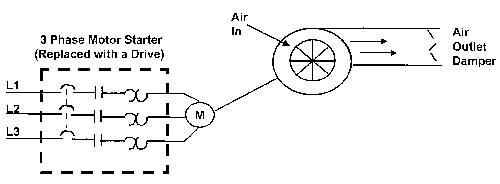
Figure 1, Fixed Speed Fan Application
A drive can control two main elements of a 3-phase induction motor: speed and torque. To understand how a drive controls these two elements, we will take a short review of AC induction motors. Fig. 2 shows the construction of an induction motor. The two basic parts of the motor, the rotor and stator, work through magnetic interaction. A motor contains pole pairs. These are iron pieces in the stator, wound in a specific pattern to provide a north to south magnetic field.
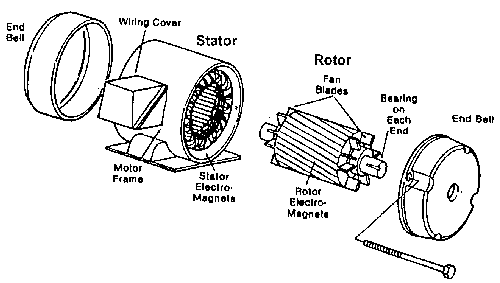
Figure 2, Basic Induction Motor Construction
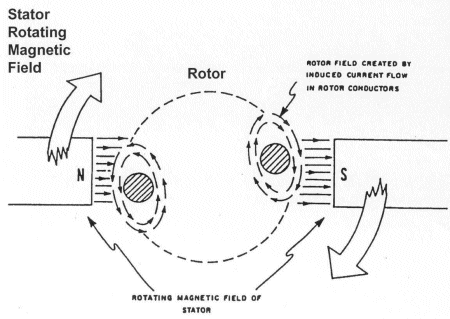
Figure 3, Operating Principles of Induction Motor
With one pole pair isolated in a motor, the rotor (shaft) rotates at a specific speed: the base speed. The number of poles and the frequency applied determine this speed (Fig. 4). This formula includes an effect called “slip.” Slip is the difference between the rotor speed and the rotating magnetic field in the stator. When a magnetic field passes through the conductors of the rotor, the rotor takes on magnetic fields of its own. These rotor magnetic fields will try to catch up to the rotating fields of the stator. However, it never does — this difference is slip. Think of slip as the distance between the greyhounds and the hare they are chasing around the track. As long as they don’t catch up to the hare, they will continue to revolve around the track. Slip is what allows a motor to turn.
| Motor Slip: | |||
| Shaft Speed = | 120 X F | – Slip | |
| Slip for NEMA B Motor = 3 to 5% of Base Speed which is 1800 RPM at Full Load | |||
| F = Frequency applied to the motor P = Number of motor poles | |||
| Example: | |||
| Shaft Speed = | 120 X 60 Hz | – Slip | |
| Figure 4, Induction Motor Slip Calculation | |||
We can conveniently adjust the speed of a motor by changing the frequency applied to the motor. You could adjust motor speed by adjusting the number of poles, but this is a physical change to the motor. It would require rewinding, and result in a step change to the speed. So, for convenience, cost-efficiency, and precision, we change the frequency. Fig. 5 shows the torque-developing characteristic of every motor: the Volts per Hertz ratio (V/Hz). We change this ratio to change motor torque. An induction motor connected to a 460V, 60 Hz source has a ratio of 7.67. As long as this ratio stays in proportion, the motor will develop rated torque. A drive provides many different frequency outputs. At any given frequency output of the drive, you get a new torque curve.
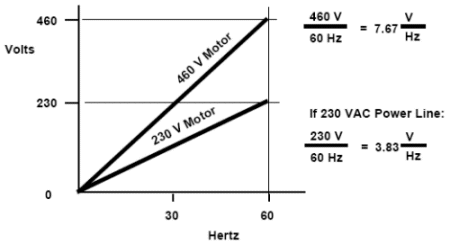
Figure 5, Volts/Hertz Ratio
How Drive Changes Motor Speed (Part 2)
This information has been provided by: ABB Inc. – Drives and Power Electronics
 Joliet Technologies has partnered with Hudson Energy, in our effects to promote energy efficiency through the use of variable speed drives.
 Joliet Technologies has also partnered with Electrical Solutions Network (ESN), in our effects to promote energy efficiency through the use of variable speed drives.