

Training Notes |
What is a Variable Frequency Drive?
How does a VFD Work?
What is a VFD? (Part 1)
By: Dave Polka
Part 2
How Drive Changes Motor Speed
Just how does a drive provide the frequency and voltage output necessary to change the speed of a motor? That’s what we’ll look at next. Fig. 6 shows a basic PWM drive. All PWM drives contain these main parts, with subtle differences in hardware and software components.
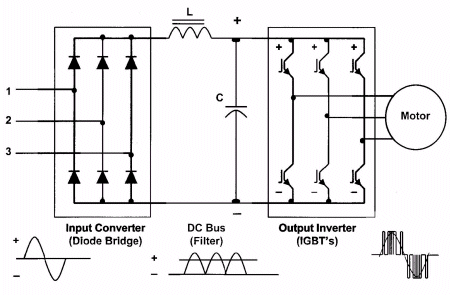
Figure 6, Basic PWM Drive Components
Although some drives accept single-phase input power, we’ll focus on the 3-phase drive. But to simplify illustrations, the waveforms in the following drive figures show only one phase of input and output.
The input section of the drive is the converter. It contains six diodes, arranged in an electrical bridge. These diodes convert AC power to DC power. The next section-the DC bus section-sees a fixed DC voltage.
The DC Bus section filters and smoothes out the waveform. The diodes actually reconstruct the negative halves of the waveform onto the positive half. In a 460V unit, you’d measure an average DC bus voltage of about 650V to 680V. You can calculate this as line voltage times 1.414. The inductor (L) and the capacitor (C) work together to filter out any AC component of the DC waveform. The smoother the DC waveform, the cleaner the output waveform from the drive.
The DC bus feeds the final section of the drive: the inverter. As the name implies, this section inverts the DC voltage back to AC. But, it does so in a variable voltage and frequency output. How does it do this? That depends on what kind of power devices your drive uses. If you have many SCR (Silicon Controlled Rectifier)-based drives in your facility, see the Sidebar. Bipolar Transistor technology began superceding SCRs in drives in the mid-1970s. In the early 1990s, those gave way to using Insulated Gate Bipolar Transistor (IGBT) technology, which will form the basis for our discussion.
Switching Bus With IGBTs
Today’s inverters use Insulated Gate Bipolar Transistors (IGBTs) to switch the DC bus on and off at specific intervals. In doing so, the inverter actually creates a variable AC voltage and frequency output. As shown in Fig. 7, the output of the drive doesn’t provide an exact replica of the AC input sine waveform. Instead, it provides voltage pulses that are at a constant magnitude.
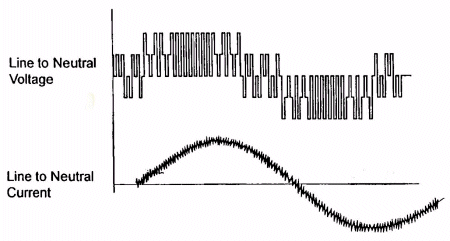
Figure 7, Drive Output Waveform
The drive’s control board signals the power device’s control circuits to turn “on” the waveform positive half or negative half of the power device. This alternating of positive and negative switches recreates the 3 phase output. The longer the power device remains on, the higher the output voltage. The less time the power device is on, the lower the output voltage (shown in Fig.8). Conversely, the longer the power device is off, the lower the output frequency.
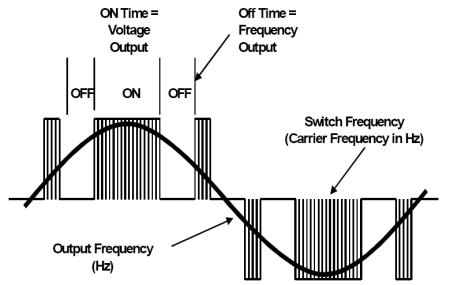
Figure 8, Drive Output Waveform Components
The speed at which power devices switch on and off is the carrier frequency, also known as the switch frequency. The higher the switch frequency, the more resolution each PWM pulse contains. Typical switch frequencies are 3,000 to 4,000 times per second (3KHz to 4KHz). (With an older, SCR-based drive, switch frequencies are 250 to 500 times per second). As you can imagine, the higher the switch frequency, the smoother the output waveform and the higher the resolution. However, higher switch frequencies decrease the efficiency of the drive because of increased heat in the power devices.
Shrinking cost and size
Drives vary in the complexity of their designs, but the designs continue to improve. Drives come in smaller packages with each generation. The trend is similar to that of the personal computer. More features, better performance, and lower cost with successive generations. Unlike computers, however, drives have dramatically improved in their reliability and ease of use. And also unlike computers, the typical drive of today doesn’t spew gratuitous harmonics into your distribution system-nor does it affect your power factor. Drives are increasingly becoming “plug and play.” As electronic power components improve in reliability and decrease in size, the cost and size of VFDs will continue to decrease. While all that is going on, their performance and ease of use will only get better.
Sidebar: What if you have SCRs?
With the large installed base of SCRs, you might want to know how these operate. An SCR (originally referred to as a thyristor) contains a control element called a gate. The gate acts as the “turn-on” switch that allows the device to fully conduct voltage. The device conducts voltage until the polarity of the device reverses-and then it automatically “turns off.” Special circuitry, usually requiring another circuit board and associated wiring, controls this switching.
The SCR’s output depends on how soon in the control cycle that gate turns on. The IGBT output also depends the length of time the gate is on. However, it can turn off anytime in the control cycle, providing a more precise output waveform. IGBTs also require a control circuit connected to the gate, but this circuitry is less complex and doesn’t require a reversal of polarity. Thus, you would approach troubleshooting differently if you have an SCR-based drive.
This information has been provided by: ABB Inc. – Drives and Power Electronics