

WEG News
July 14, 2008 (Press)
Billions of Dollars in Energy Could Be Lost Annually Due to Poor Motor Sizing
Energy efficiency losses through oversizing of pump electric motors by engineers are commonplace and, if the motor specification far exceeds the application, it could be costing industry billions of dollars in wasted energy.
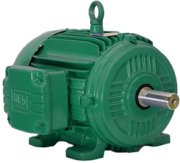 ATLANTA, Georgia, July 9, 2008 – WEG Electric Motors Corp. (www.weg.net), a leading global supplier of motors, drives, controls, generators, and transformers, explains how proper motor sizing could easily save vast amounts of energy. Energy efficiency losses through oversizing of pump electric motors by engineers are commonplace and, if the motor specification far exceeds the application, it could be costing industry billions of dollars in wasted energy.
“Industry figures suggest that around 80% of pump motors could be the incorrect size,” commented Andrew Glover, Product Manager for WEG Motors. “The majority are over specified by as much as 10 or 15% by engineers wanting to be ‘on the safe side.’ As pumps typically account for around 30% of an industrial country’s energy usage, this represents a serious loss of energy.”
“This takes no account for the extra cost of a larger motor with all the associated equipment, drives, cabling etc.,” continued Glover. “Electric motor manufacturers are forever striving to increase energy efficiency by one or two percentage points, but incorrect specification by an application engineer can mean that is wasted effort.”
“Where a single percentage point increase in energy efficiency can save the equivalent of the purchase price of an electric motor over its design life, it seems ludicrous to waste energy through poor specification.”
Under-sizing is also relatively common and should not be ignored. An electric motor can operate above its rated output thus allowing for temporary overloads. However, such a motor will run hotter as a result and overheating will cause damage and/or shorten its useful life.
Two points where this can directly affect the motor life are the bearings, which influence the motor reliability, and the coil insulation. Overheating degrades the insulation more rapidly and encourages discharges which further degrade the insulation, thus shortening the motor’s life.
Specification of motor size should, therefore, include starting condition as well as running torque. Method of starting is also important; direct on line starting methods will create high torque that also impose mechanical stresses on the pump and hydraulic components, while star delta starting delivers lower torque and current.
Including a variable speed drive or soft starter in the system specification, matched to the requirements of motor and pump will easily overcome these problems. Variable speed drives also improve energy efficiency in the long term by matching application requirements with the correct motor speed and thus avoid energy wasted by, for example, belt drives, clutches and gears.
For additional information or to have a WEG application engineer contact you, please visit www.weg.net or call 1-800-ASK-4WEG.
About WEG Electric Motors Corp. Founded in 1961, WEG has grown into a global solutions provider of industrial electrical technologies. WEG is the largest industrial electric motor manufacturer in the Americas and one of the largest manufacturers of electric motors in the world producing over ten million units annually. Committed to growth on a global scale, WEG continually invests in state-of-the-art manufacturing facilities and processes, and the development of new and improved industrial electrical solutions. WEG offers a diverse and integrated product line that includes motors, drives, controls, transformers, and generators. WEG has committed to an R&D investment of 3% of annual, global sales.
Contact Joliet Technologies for WEG Motor Pricing:
Phone: (815) 725-9696 or
Toll Free: (866) 492-9888
Fax: (815) 725-9393
E-mail: info@joliettech.com
RFQ – Request for Quote
| |